


How to Track Cash Withdrawals Correctly
Treat an ATM withdrawal as money moving from bank to wallet, with fees and conversion recorded separately, so your spending reports stay honest on the road.
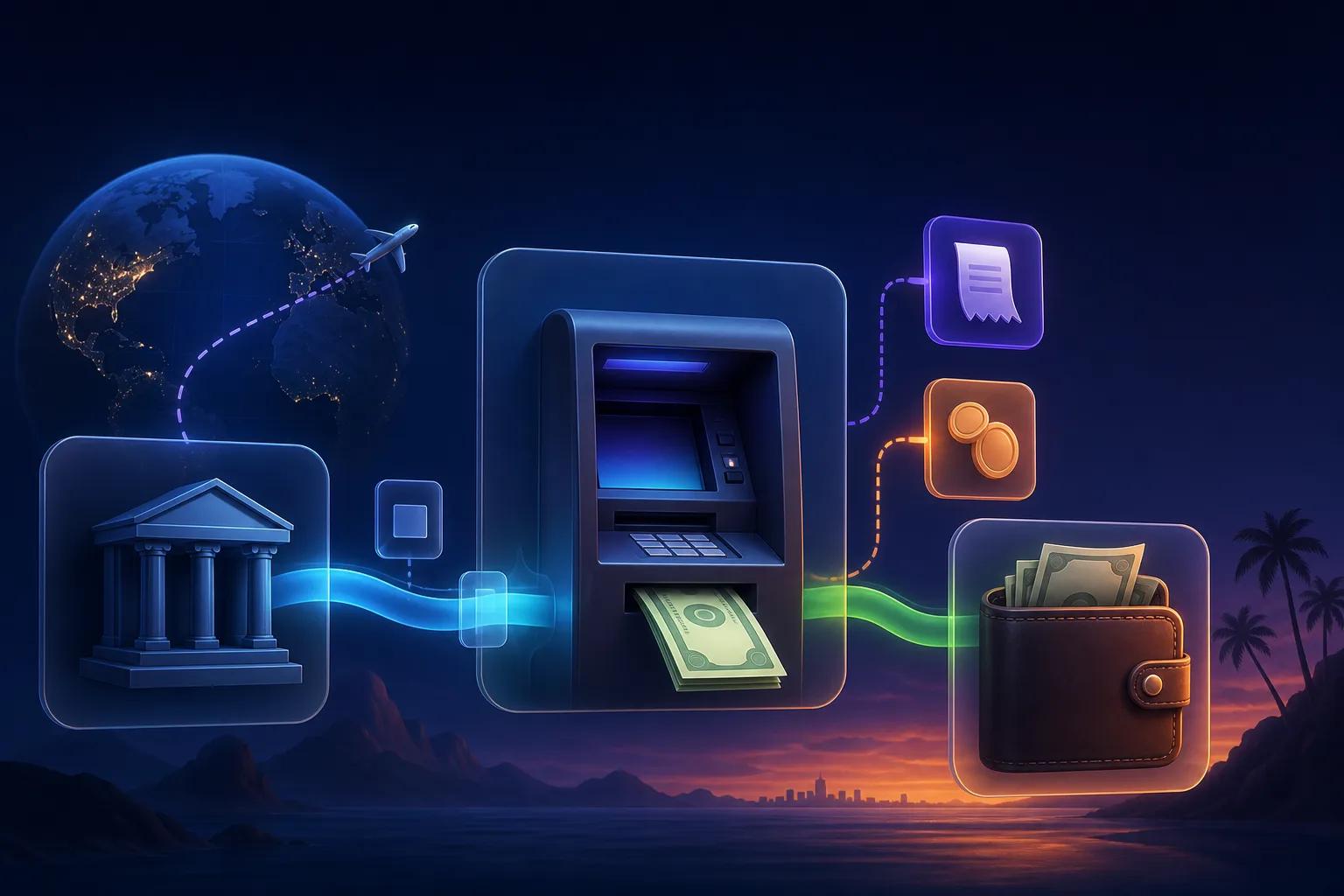
Cash is still part of everyday nomad life. You might pay rent deposits in cash, leave small tips, buy produce at a market, split a scooter rental, or keep emergency notes tucked away for a bus route that does not accept cards. The mistake many people make is recording the full ATM withdrawal as an expense. Most of the time, it is not. It is a transfer from your bank account into your cash wallet, plus any fees or currency conversion differences that belong in separate places.
The simple rule: the cash is not spent yet
When you withdraw money from an ATM, the main amount is usually still yours. It has simply changed form. Before the withdrawal, it lived as a balance in your bank account. After the withdrawal, it lives as notes in your wallet. If you record the full withdrawal as an expense, your reports will say you spent that money immediately, even though you may still be holding it for groceries, transport, rent, tips, laundry, or nothing at all.
This matters because cash often gets spent slowly and unevenly. You might take out the equivalent of a week of living costs on Monday, then use it over ten days. Or you might withdraw a larger amount because the ATM fee is annoying and you want fewer withdrawals. Treating the withdrawal as one big expense makes your daily and category reports misleading. It can look like Monday was expensive and the rest of the week was free, when the reality was much more normal.
A cleaner method is to create a cash account, sometimes called Wallet, Cash on Hand, or Local Cash. The withdrawal becomes a transfer from your bank account to that cash account. Then, as you actually spend the notes, you record the real expenses from the cash account. Your grocery purchase is groceries. Your taxi is transport. Your SIM top-up is phone or connectivity. The cash withdrawal itself is just the moment the money moved into a different pocket.
- Record the ATM withdrawal amount as a transfer from Bank to Cash Wallet.
- Record the ATM fee as a separate bank fee or ATM fee expense.
- Record any local ATM surcharge separately if it appears as its own charge.
- Record your later cash purchases from the Cash Wallet account, not from the bank.
- If the withdrawal crosses currencies, keep the bank-side and cash-side amounts visible so the exchange rate is understandable.
Separate the three things that happen at the ATM
An ATM withdrawal can feel like one event, but financially it may contain several different events. There is the amount you receive in local cash. There may be a fee charged by the ATM operator. There may be a fee charged by your bank. There may be a currency conversion spread or a foreign transaction fee. Sometimes these appear immediately. Sometimes they settle a few days later. Sometimes the ATM screen offers dynamic currency conversion, where it asks whether you want to be charged in your home currency instead of the local currency. That choice can affect how the transaction appears and what rate is used, so it is worth noting rather than trying to reconstruct it weeks later.
A practical tracking approach does not require perfection. The goal is to avoid hiding real costs inside the withdrawal amount. Suppose you withdraw 5,000 Thai baht. Your bank later shows a debit equivalent to 5,000 baht plus a foreign ATM fee. If you record the whole bank debit as “cash spending,” you lose the distinction between money you still have and money you paid to access it. Instead, your cash wallet receives 5,000 baht, and the fee becomes a fee expense. If your bank statement is in euros, dollars, pounds, or another currency, the bank side of the transfer reflects the amount that left that account, while the cash side reflects the local notes you received.
This is especially useful when you compare countries or routines. Some places are cash-heavy but cheap. Others are card-friendly but full of small card fees or poor exchange rates. If ATM fees are recorded separately, you can see whether withdrawing larger amounts less often helps, whether a different card behaves better, or whether using card payments is cleaner for that destination. You do not need to turn your life into a spreadsheet project. You just need the main money movement and the access costs to stop pretending they are the same thing.
- Transfer: the amount that moved from your bank balance into your cash wallet.
- ATM operator fee: a local surcharge charged for using that machine, if shown.
- Bank or card fee: a charge from your own provider, sometimes posted separately.
- Currency conversion difference: the effect of exchange rates, spreads, or settlement timing.
- Real cash expenses: the later purchases you make with the notes in your wallet.
How to handle currency conversion without overthinking it
Cash withdrawals are often where multi-currency tracking gets messy. Your bank account might be in one currency, the ATM dispenses another, and your mental budget may be in a third. For example, you earn in USD, your bank card settles in EUR, and you withdraw Georgian lari, Mexican pesos, or Vietnamese dong. The cleanest method is to respect each side of the transaction. The bank account loses the amount shown by the bank. The cash wallet gains the amount you actually received in local currency. The implied exchange rate is whatever connects those two values.
You do not always need to manually calculate that rate. What matters is that the cash wallet starts with the correct local amount. If you received 2,000 pesos, your cash wallet should increase by 2,000 pesos. Then your spending in that destination can be recorded naturally in pesos: tacos, local bus, market vegetables, laundry, haircut, coworking day pass, or a cash deposit. Your bank report can still show what the withdrawal cost in your bank currency. This gives you two useful views: how much local cash you have and how much it cost you to get it.
Settlement timing can create small differences. A pending card transaction may show one amount today and settle at another amount tomorrow. If you are tracking manually, it is usually fine to adjust the bank-side amount once it settles. If you are importing transactions, you may need to match the bank debit to your cash transfer after it becomes final. Avoid obsessing over tiny rate differences unless they matter to your decision-making. For most people, consistency matters more than precision down to the last cent, satoshi reference value, or minor rounding unit. Crypto-related reference tracking can be especially volatile and platform-specific, so treat it as informational rather than a precise spending or tax conclusion.
- Use the actual cash received as the cash account increase.
- Use the settled bank debit as the bank account decrease.
- Let the implied exchange rate explain the difference between the two.
- Adjust pending transactions only after they settle if the final amount changes.
- Keep fees separate so the exchange rate does not absorb costs that should be visible.
Build a cash routine that survives real nomad life
The hardest part is not understanding the accounting. It is remembering what happened after a long bus ride, a late arrival, or a week of small local purchases. Cash disappears in quiet ways. A few coins for public toilets. A tip for a porter. A fruit stand. A beach chair. A shared taxi where one person pays the driver and everyone else pays that person. A landlord who wants a cash deposit and promises to return it later. If you wait too long, your wallet balance stops matching reality and you are left guessing.
A lightweight routine helps. Count your cash when you withdraw it. Record the withdrawal before you leave the ATM area or as soon as you are somewhere safe. Keep the ATM receipt only if it is useful to you and does not expose information you would rather not carry around. When you spend cash, record the transaction quickly if it is meaningful, or batch tiny purchases into a daily “cash small items” entry if that is more realistic. The right routine is the one you will still do when tired, not the one that looks perfect on a quiet Sunday morning.
In Nomad Flow, this is one of the reasons a local-first cash account can be useful: you can keep a simple local wallet balance next to your bank accounts without turning every withdrawal into a false expense. The point is not to capture every coin for its own sake. The point is to keep your reports honest enough that you can tell the difference between living costs, access fees, deposits, reimbursements, and money that is still in your pocket.
- Record the withdrawal while the amount is fresh.
- Use a separate cash wallet for each currency if you regularly hold more than one.
- Batch tiny cash purchases when individual tracking becomes too much.
- Count your wallet every few days and add an adjustment if needed.
- Write short notes for unusual cash events, such as deposits, reimbursements, or shared payments.
Common cash withdrawal mistakes and better alternatives
The most common mistake is categorizing the whole withdrawal as “ATM,” “cash,” or “miscellaneous expense.” This feels easy, but it pushes future spending into the wrong date and wrong category. Your food budget becomes understated because groceries bought with cash never appear as groceries. Your fee budget becomes invisible because ATM costs are buried inside cash. Your monthly totals become distorted because one large withdrawal can make a month look more expensive even if some of that cash is still unspent at the end of the month.
Another common mistake is ignoring cash balances entirely. This can work if you use cash rarely and only for tiny purchases, but it becomes fragile in cash-heavy places. If you pay rent, deposits, utilities, local transport, or daily meals in cash, an untracked wallet creates a blind spot. It is also easy to double count. For example, you may mark the withdrawal as an expense, then later record a cash rent payment too. Now the same money has been spent twice in your records, even though only one real expense happened.
A better alternative is to decide your level of detail before you need it. If you are in a card-friendly city for two weeks and only withdraw a small emergency amount, you may record the withdrawal as a transfer and use one adjustment when you leave. If you are staying three months in a neighborhood where rent, laundry, markets, and transport are cash-based, a proper cash wallet is worth the small effort. If you use cash for business-related purchases, client reimbursements, or anything you may later discuss with an accountant, keep notes and receipts where appropriate. This is general recordkeeping guidance, not tax or legal advice; requirements vary by country, residency situation, and business structure, so verify what applies to you.
- Do not record the full withdrawal as an expense if you still hold the cash.
- Do not hide ATM fees inside grocery, rent, or travel categories.
- Do not mix currencies in one cash wallet unless you are comfortable losing detail.
- Do not forget deposits: money handed over as a refundable deposit is different from rent paid.
- Do not chase perfect records at the cost of a routine you will abandon.
A practical example from withdrawal to final spending
Imagine you arrive in a city where cash is useful for markets and taxis. You withdraw 3,000 units of local currency from an ATM. The machine says it will charge a local ATM fee. Your bank later shows the withdrawal in your bank currency, plus a separate international fee. In your tracker, you create a transfer from your bank account to your Local Cash wallet for the 3,000 local units. Then you record the local ATM fee and bank fee as expenses, either from the bank account or as they appear on the statement. Now your cash wallet says you have 3,000 local units available to spend.
Over the next few days, you pay 900 for groceries, 250 for a taxi, 120 for laundry, 60 for coffee, and 1,000 as a refundable key deposit for a short apartment stay. The groceries, taxi, laundry, and coffee are expenses from the cash wallet. The key deposit is not necessarily a living expense in the same way; you might record it as a deposit or receivable so that, when it is returned, it does not look like income. If the landlord later returns only 800 because 200 is kept for cleaning, you can record 800 back into cash and 200 as the actual cleaning or housing expense, depending on your categories.
At the end of the week, your wallet should roughly match your tracker. If the tracker says you should have 670 but you count 650, you can either look for the missing transaction or add a small cash adjustment. Small differences happen. Coins get rounded, tips get forgotten, and shared payments get messy. The point of the system is not to shame you over 20 units of local currency. It is to keep the big picture clear: the withdrawal moved money, the fees cost money, the purchases explain where the cash went, and the remaining balance is still yours.
- Step 1: Bank to Local Cash transfer for the amount received.
- Step 2: Separate fee expense entries for ATM and bank charges.
- Step 3: Real purchases recorded from Local Cash as they happen.
- Step 4: Deposits tracked separately when you expect money back.
- Step 5: Occasional cash adjustment for small differences you cannot reconstruct.
Final thought
Cash tracking gets easier when you stop treating the ATM as a shop. The withdrawal is usually just a transfer into your wallet; the fee is the cost; the later purchases are the real spending. Keep those pieces separate and your nomad budget will feel calmer, more accurate, and much easier to trust.