


The Nomad Money Stack: Cash, Card, Bank, Wallet, Crypto
A practical guide to building a layered money setup for life across currencies, so one blocked card or delayed transfer does not stop your week.
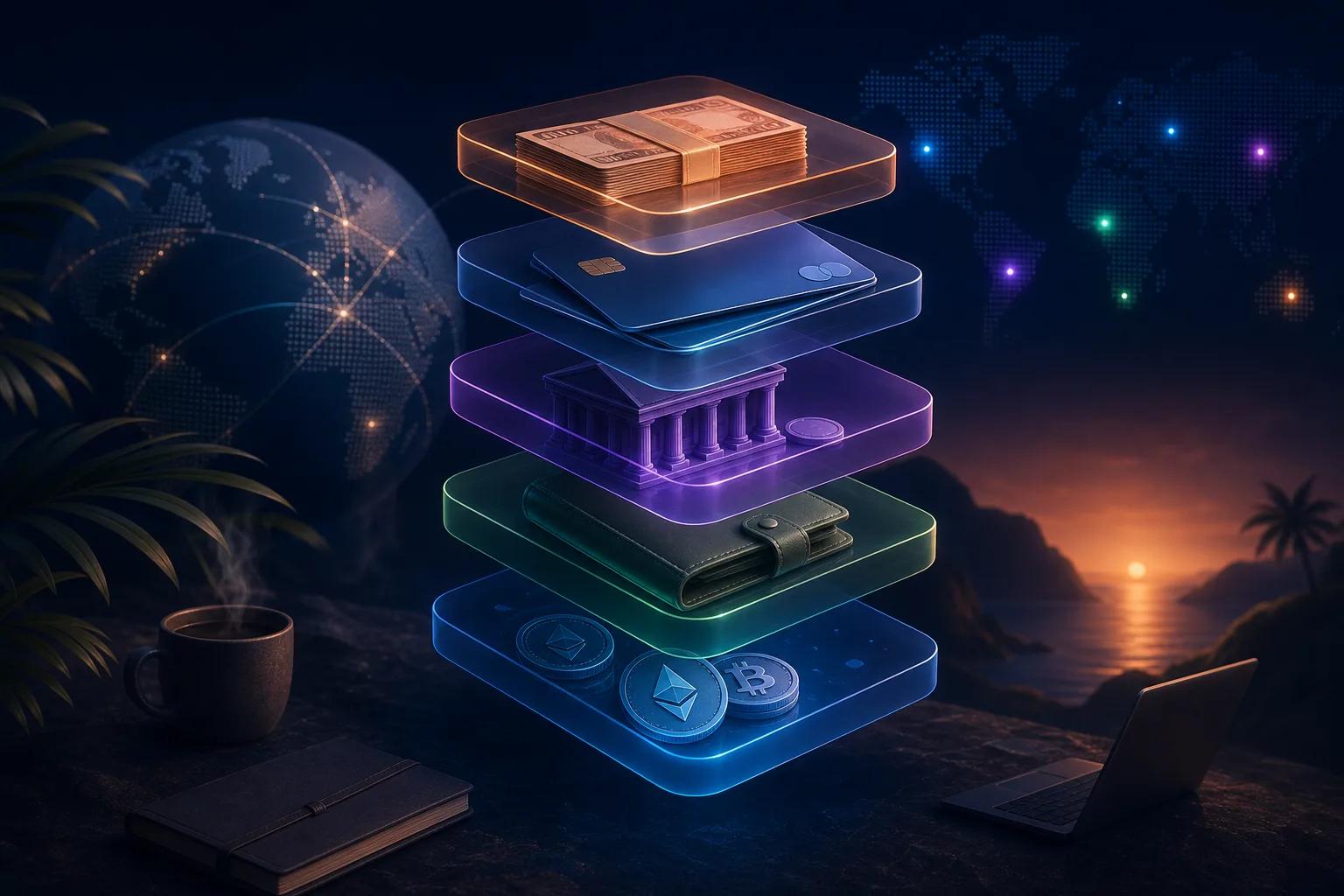
There is no perfect money provider for nomad life. The card that works beautifully in Lisbon may fail at a bus station in Albania. The transfer that arrives in minutes one month may take three days the next. A local rent deposit may need cash, while your income lands in another currency and your subscriptions quietly renew in a third. A good nomad money stack is not about finding one app, one bank, or one card to trust forever. It is about building layers, so everyday life keeps moving when one layer is slow, blocked, expensive, or simply unavailable.
Why a money stack works better than a single solution
A money stack is the set of tools you use to receive, hold, spend, move, and track money. For someone living in one country, it might be simple: one bank account, one debit card, a little cash, and maybe a credit card. For a digital nomad, remote worker, or freelancer crossing borders, the stack usually becomes more textured. You may receive client payments in USD or EUR, pay rent in a local currency, use a travel card for groceries, keep emergency cash in the apartment, and move money through a wallet or transfer service when banks are slow.
The point is not to make your finances complicated. The point is to make them resilient. If your only card is swallowed by an ATM, your only banking app asks for a phone number you no longer have, or your only transfer route is under maintenance on rent day, you do not want the entire week to depend on one support ticket. A layered setup gives you options before you need them. It also helps you notice the real cost of convenience: exchange rates, ATM markups, subscription renewals, foreign transaction fees, and the mental load of remembering where everything went.
The healthiest stack is usually boring. It has a primary card for daily spending, a backup card stored separately, enough cash for local routines, a bank account or wallet for receiving income, a transfer path that you have already tested, and a simple way to track balances and categories. It does not need to be perfect. It needs to be understood by you, documented enough that future-you can manage it, and flexible enough to survive a messy Tuesday.
- Treat money access as infrastructure, not as a one-time setup.
- Separate daily spending, backup access, and emergency reserves where possible.
- Test important routes before you rely on them for rent, deposits, or travel days.
- Review the stack after each country move, because local habits change the practical design.
Layer one: cash for the places where cards still feel optional
Cash is often the least glamorous part of nomad finance, but it solves very real problems. It covers small markets, buses, laundry, tips, neighborhood cafés, key deposits, repair people, shared taxis, and the occasional landlord who does not want to wait for a transfer. In many places, card payments are common in polished areas and less reliable just a few streets away. A calm cash habit prevents small errands from becoming negotiation practice.
The challenge is deciding how much to hold. Too little cash creates friction; too much creates risk and makes spending harder to reconstruct later. A practical approach is to think in time periods rather than round numbers. Ask yourself: if ATMs stopped working for two or three days, could I buy food, get local transport, and handle a small surprise? If your apartment owner asked for a refundable key deposit in cash, would that ruin your plan? If you needed to leave early in the morning, could you pay a driver or local bus without hunting for an ATM?
Cash also needs a routine once it enters your life. When you withdraw, note the amount, the currency, and the reason. If you exchange money, record the rate you actually got, not the rate you saw online five minutes earlier. When you spend cash, do not aim for perfect receipt-level tracking unless that suits you. A simple daily or weekly cash adjustment can be enough: withdrew 200, still have 85, cash spending was 115. The goal is not courtroom precision. It is preventing cash from becoming a financial fog.
- Keep cash in more than one place when it is sensible: wallet, apartment, and travel pouch, not all together.
- Use smaller notes when possible, especially for markets, buses, and small shops.
- Avoid treating ATM cash as already spent; it is still money until it leaves your hands.
- Create a simple label such as cash local, cash travel, or cash buffer so it is visible in your tracking.
Layer two: cards for daily life, backups, and the invisible cost of convenience
Cards are the workhorse of most nomad money stacks. They pay for groceries, coworking spaces, train tickets, flights, apps, hotels, and online tools. They also create a clean transaction trail, which makes budgeting easier than a pocket full of receipts in five currencies. But card life across borders has its own failure modes: blocked transactions, damaged chips, dynamic currency conversion screens, expired cards sent to old addresses, and merchants that accept cards from some networks but not others.
A strong card layer usually has roles. One card is for everyday spending. Another is a backup, ideally from a different provider or network. A third may be reserved for online subscriptions, flights, deposits, or situations where a hold might reduce your available balance. If you use credit cards, debit cards, prepaid cards, or travel cards, the exact mix depends on your eligibility, country of residence, fees, and risk tolerance. What matters is that you understand what each card is for and what happens if it stops working.
The most overlooked card habit is declining unnecessary currency conversion at the point of sale or ATM when appropriate. Many terminals offer to charge you in your home currency instead of the local currency. It can feel helpful, especially when you are tired, but the exchange rate may be less favorable. You do not need to memorize every rate; you just need a default habit of pausing before accepting a conversion screen. The same goes for ATM fees and withdrawal limits. One expensive withdrawal is not a crisis, but repeated unexamined fees can quietly become a category of their own.
- Carry at least two cards and store them separately, especially on travel days.
- Use one card for recurring subscriptions if that makes renewals easier to review.
- Check whether hotel, car, bike, or apartment deposits create temporary holds that affect cash flow.
- When a terminal asks which currency to use, pause and read the screen before tapping.
Layer three: banks, wallets, and transfer routes for rent, income, and timing gaps
The bank and wallet layer is where nomad money gets less visible but more important. This is the layer that receives salary or client payments, holds savings, pays larger bills, funds your cards, and moves money between currencies. It is also where timing matters. A freelancer invoice may arrive late. A platform payout may clear after the weekend. A rent payment may need to land before the first of the month. A deposit may be refundable, but not soon enough to help with the next deposit.
For many long-stay nomads, the practical stack includes a home base account, one or more multi-currency accounts or wallets, and a transfer service they trust enough to use but do not blindly rely on. Some people also open local accounts where they are eligible and where it makes everyday life easier. A local bank can simplify rent, utilities, mobile plans, or deposits, but it may also add paperwork, language barriers, app limitations, and account closure questions when you leave. Eligibility and obligations vary, so it is worth checking requirements carefully rather than assuming what worked for another traveler will work for you.
Transfers deserve special respect. Before you depend on a new route for a large payment, test it with a smaller amount. Save recipient details carefully. Add notes that will make sense later. Keep screenshots or confirmations for your own records, especially when paying deposits or shared rent. If a payment is important, do not schedule it at the last possible moment in a new country, on a weekend, during a banking holiday you forgot about, or while your phone number is unstable. The boring buffer between income arriving and rent leaving is one of the most underrated luxuries in nomad life.
- Keep a small timing buffer in the currency used for rent or core living costs when possible.
- Test new transfer routes before using them for deposits, rent, or urgent travel expenses.
- Separate client income, tax set-asides, living money, and savings if your tools allow clear buckets.
- Write transfer notes that future-you can understand, such as apartment deposit, July rent, or coworking refund.
Layer four: crypto, reference tracking, and records without pretending it is simple
Crypto sits differently in every nomad stack. For some people it is irrelevant. For others it is a small reference balance, a way to understand part of their net worth, a payment method in limited situations, or a volatile asset they do not want mixed into grocery budgeting. Because crypto can involve price swings, platform risk, custody choices, tax questions, and legal differences between countries, it deserves a cautious and clearly labeled place in your system. This article is not investment, tax, legal, or financial advice; rules and risks vary by jurisdiction and personal situation, so verify details with qualified sources when needed.
The practical question is not whether crypto belongs in every stack. It does not. The question is how to avoid confusion if it is part of yours. If you hold crypto, decide whether you are tracking it as spendable money, long-term reference value, business-related income, or something else. Those categories should not blur together. A balance that changes by the hour can distort your sense of monthly affordability if you treat it like cash. A token received for work may need more careful records than a personal experiment. A wallet transfer between your own addresses is not the same as spending, even if it looks like activity.
This is where local-first tracking can help keep the picture grounded. In Nomad Flow, for example, you might keep a simple reference account for crypto values while still keeping rent, food, transport, and cash spending in their real currencies. The benefit is not prediction; it is separation. Your daily budget stays connected to the money you can actually use for daily life, while your broader financial picture can include assets or balances that do not behave like a normal bank account.
- Label crypto clearly as reference, investment, business income, or spending only if that reflects your real use.
- Do not mix volatile balances into your grocery or rent budget unless you intentionally convert them.
- Keep records of dates, amounts, counterparties, and purpose for transfers that may matter later.
- Be cautious with public Wi-Fi, device security, recovery phrases, and platforms you do not understand.
How to design your own stack without overbuilding it
A good stack starts with your actual routine, not an abstract checklist. Write down how money enters your life, where it rests, and how it leaves. Income might arrive through payroll, freelance platforms, direct client transfers, royalties, or business revenue. Spending may happen through cards, cash, bank transfers, mobile wallets, or shared payments with partners and housemates. Your stack should reflect the shape of your month: rent day, subscription day, market day, coworking day, travel day, and the day you finally replace the charger you left in another apartment.
Then look for single points of failure. If one card fails, can you still buy groceries? If your main phone is lost, can you access enough money to get through the week? If a transfer is delayed, can you still pay rent? If an ATM keeps your card, is another card stored somewhere else? If your home bank wants verification, do you have access to the phone number, email, address, or documents they may request? These questions are not meant to create anxiety. They are practical maintenance, like checking that your passport has blank pages before a border crossing.
Finally, reduce the number of tools until the system is usable. Nomads often accumulate financial leftovers: old cards, half-used wallets, dormant local accounts, mystery subscriptions, payment apps from a city they left, and small balances in currencies they may not use again soon. More tools can mean more resilience, but only if you understand them. If a provider adds confusion, fees, or security risk without a clear role, it may be clutter. A calmer stack is layered, not scattered.
- Map your monthly money flow: receive, hold, convert, spend, save, and document.
- Assign a role to each tool: daily, backup, rent, income, travel, emergency, or reference.
- Retire or archive tools that no longer have a job, after checking balances and records.
- Review your stack whenever you change countries, income sources, housing style, or travel pace.
Final thought
The nomad money stack is not about having every possible account, card, wallet, and asset. It is about knowing which layer does what, keeping enough redundancy for ordinary disruptions, and tracking the messy reality of life across currencies. Build it slowly, test it before emergencies, and let it stay simple enough that you can understand it on a tired travel day.