


Why Your App Should Not Need Your Bank Login
Bank connections can save time, but useful money tracking should still work without handing over every account login to another service.
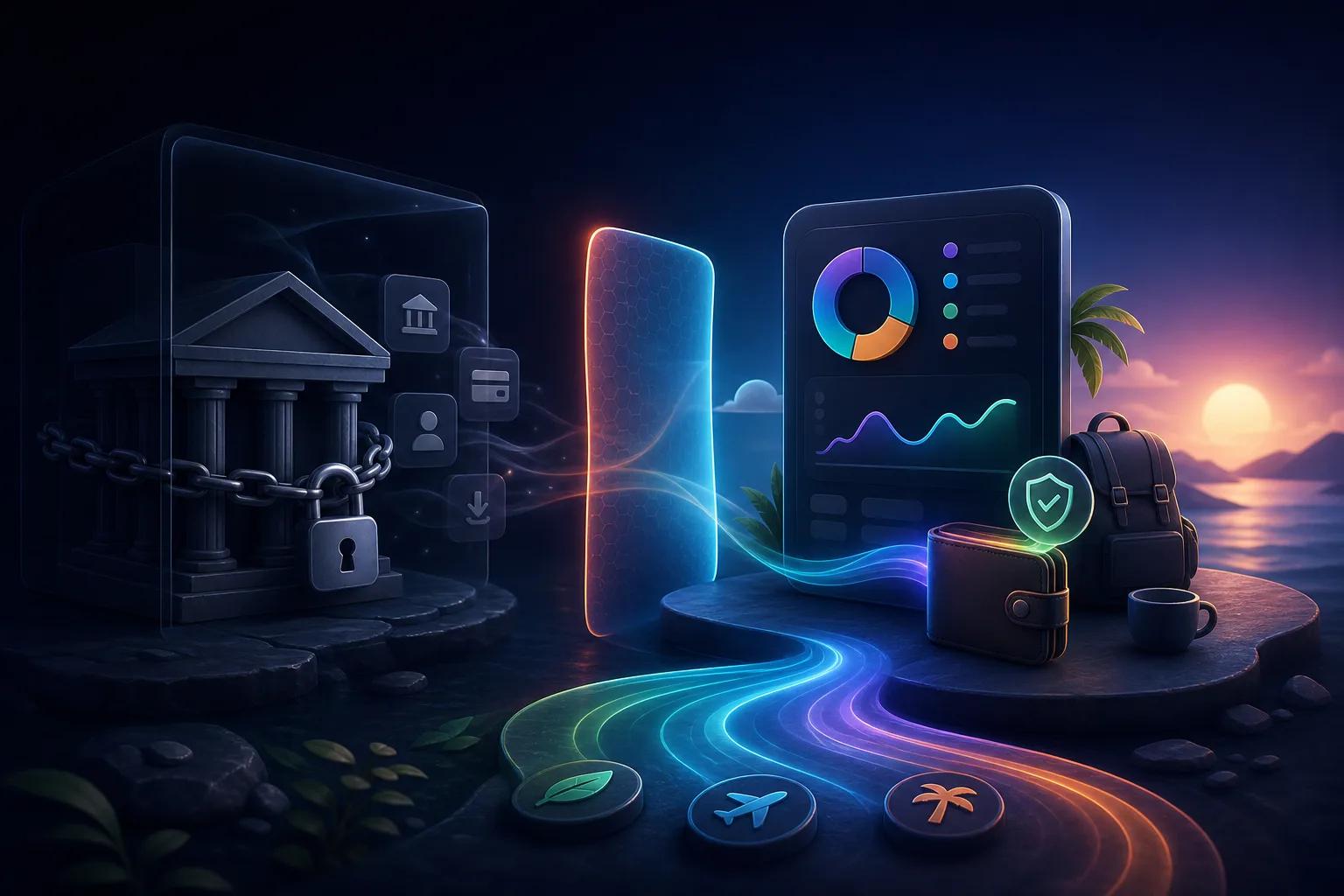
For many people living across borders, money is not a neat feed from one bank. It is rent paid by transfer, cash from an ATM, a card used in three currencies, a deposit held by a landlord, a client payment that arrives late, and a subscription you forgot was still tied to your old country. Bank connections can help in some cases, but they should not be the price of understanding your own money.
Bank feeds are convenient, but they are not neutral
A connected bank feed can feel like magic the first time it works. Transactions appear by themselves, dates are filled in, and the app has something useful to show before you have done much work. For people with a stable set of accounts in one country, that convenience can be real. It removes some friction, especially for recurring card spending and salary deposits. The problem is not that bank connections are useless. The problem is when an app treats them as the only serious way to track money.
The moment a personal finance app asks for a bank login, the relationship changes. You are no longer just entering information into a tool you control. You are granting access, directly or through a third-party connection provider, to an account that may be linked to your identity, income, savings, transfers, addresses, and spending patterns. Even when the connection is read-only, even when it uses a reputable provider, and even when the app has good intentions, it expands the number of systems involved in your financial life.
For digital nomads, that tradeoff deserves extra thought. Your banking setup may already include multiple cards, fintech accounts, local bank accounts, payment platforms, cash wallets, and currency balances. Some may connect easily; others may not connect at all. A feed that works in one country may break in another. A card transaction may arrive with a delayed merchant name, a confusing currency conversion, or a temporary authorization that disappears later. The useful question is not whether bank feeds are good or bad. It is whether your tracking system still works when the feed is incomplete, unavailable, or not worth the privacy cost.
- A bank feed can reduce manual entry, but it can also create dependence on access you do not fully control.
- Connected data is often shaped by banks, processors, and aggregators before it reaches your app.
- For people who move often, the accounts that matter most are not always the accounts that connect cleanly.
Nomad money is messier than a single transaction stream
A lot of finance software is designed around a simple domestic pattern: one salary account, one credit card, one rent payment, one tax system, and predictable monthly bills. Long-stay nomad life rarely looks like that. You may pay your apartment deposit in cash, your monthly rent by local transfer, your coworking space by card, your visa run by bus ticket, and your phone plan through a local app that sends receipts in another language. You may also receive income into one currency, spend in another, and keep a third as a buffer because it is easier to use where you are now.
This is where bank-login-first design can become misleading. A connected account may show what cleared, but not why it mattered. It may not show that an ATM withdrawal was meant to cover groceries for two weeks, that a transfer was repayment from a travel partner, or that a hotel charge was actually a temporary housing cost while waiting for an apartment. It may record a currency-converted amount but not the local price that helped you decide whether a neighborhood was affordable. The feed captures the financial event, but not always the context.
There are also entire parts of nomad money that may never appear in a bank feed in a useful form. Cash is still common in many places. Deposits can be held outside formal platforms. Friends split costs through informal transfers. Freelancers may use several payment services before money reaches a bank. Some people keep a reference list of crypto holdings or stablecoin movements for personal visibility, even if they are not using that information for investing decisions. This article is not tax, legal, crypto, or investment advice, and rules vary by place and situation. The practical point is simpler: your finance app should let you record reality without pretending every meaningful money event begins with a bank connection.
- Cash spending and ATM withdrawals need notes, categories, and local context, not just cleared card data.
- Rent, deposits, and shared costs often need manual records because the explanation matters as much as the transfer.
- Currency conversion is easier to understand when you can keep both the local amount and your home-reference amount visible.
Privacy is not about hiding; it is about reducing unnecessary exposure
People sometimes talk about financial privacy as if it means being secretive. For most nomads, it is more practical than that. Privacy means not spreading sensitive data into more places than necessary. It means having a tool for your own clarity without automatically creating a detailed external copy of your financial life. It means being able to track spending in a new city, compare rent options, or review subscriptions without first handing over credentials or account access.
Bank-login workflows can involve several layers: the app you use, a data connection provider, the bank, and sometimes additional infrastructure that processes or stores transaction information. Each layer may have its own security practices, retention rules, terms, and failure points. None of this automatically means something bad will happen. It does mean the decision is bigger than clicking a button because setup is faster. If you would not casually email a stranger your last year of bank statements, it is reasonable to ask what data an app truly needs to help you budget, categorize, and plan.
A privacy-first approach does not require paranoia. It asks for proportionality. If you only need a monthly overview, maybe you do not need continuous account access. If you mainly want to understand your cost of living in Lisbon, Chiang Mai, Tbilisi, Medellín, or wherever you are staying next, you may get more value from careful categories and currency notes than from a live bank sync. If you are tracking subscriptions, you may need a simple recurring list and reminders, not a full map of every transaction in every account. The less data a tool needs, the less data can be exposed, sold, breached, misunderstood, or locked away from you.
- Privacy-first finance is about collecting enough information to be useful, not every possible detail by default.
- A tool can respect your money life by making bank access optional rather than mandatory.
- Reducing data exposure is especially helpful when your financial setup spans multiple countries, providers, and devices.
A useful tracker should work offline, manually, and across currencies
The best test of a finance tracker for nomads is not whether it looks impressive on the first day. It is whether you can keep using it on a tired Tuesday after a border crossing, with spotty internet, a receipt in your pocket, and three currencies in your head. Local-first tools are valuable here because they treat your device as the primary place where your records live and work. You should be able to add an expense on a train, update a cash balance at a market, or check your monthly housing total without waiting for a remote service to approve your access.
Manual entry is often described as a burden, but for nomad finance it can be a form of attention. When you enter a rent payment, you can attach the month it covers. When you record an ATM withdrawal, you can split it later between groceries, taxis, laundry, and small local purchases. When you pay in local currency, you can keep the amount that mattered at the counter and a reference amount in your main planning currency. This makes the record more human than a raw bank feed. It also helps when bank descriptions are vague, duplicated, delayed, or translated badly.
This is the kind of workflow Nomad Flow is built around: privacy-first, local-first tracking that does not require a bank login to be useful. That does not mean automation is always wrong. It means the foundation should be your own records, categories, balances, currencies, and routines. If a tool ever adds import or connection options, they should support your system rather than replace it. For many long-stay travelers and remote workers, the durable habit is not perfect automation. It is a simple money check-in that survives new apartments, new SIM cards, new cards, new banks, and new routines.
- Offline entry matters when travel days, weak connections, or bank verification flows get in the way.
- Manual records let you capture intent: deposit, reimbursement, business expense, housing, travel, or shared cost.
- Multi-currency tracking should help you understand both the local price and the planning impact in your reference currency.
What to look for before giving any app bank access
Sometimes a bank connection may be worth it. If you have a high-volume account with many small card transactions, importing data can save time. If your bank and app support a well-scoped connection, and you are comfortable with the providers involved, it may fit your routine. The key is that access should be a choice, not an entry fee. A personal finance app should be able to prove its usefulness before it asks for sensitive permissions.
Before connecting anything, slow down and read the request in plain language. What accounts will the app see? Can it view balances, transactions, account numbers, identity details, or other information? Is access read-only? Can you revoke it easily from the bank side? How long is data retained if you disconnect? Does the app still work if the connection breaks? These are practical questions, not technical ones. They help you decide whether the convenience is proportionate to the exposure.
Also consider whether the feed will actually solve your specific problem. If your pain is forgetting subscriptions, a recurring expense list may be enough. If your pain is understanding local cost of living, careful categories may help more than raw imports. If your pain is freelance cash flow, you may need invoice dates, expected payment dates, transfers, buffers, and notes. If your pain is shared travel spending, you may need splits and reimbursements. A bank login can show transactions, but it cannot automatically understand the life around them.
- Can you use the app fully without connecting a bank?
- Does the app explain what data it accesses and why it needs it?
- Can you export your records in a usable format if you leave?
- Does it handle cash, transfers, deposits, reimbursements, and multiple currencies cleanly?
- Will your tracking still make sense if a feed is delayed, duplicated, or disconnected?
Build a money routine that does not depend on permission
A resilient money system starts with a few categories that match your life, not a template designed for someone else. For a nomad, that might mean housing, deposits, groceries, eating out, transport, coworking, mobile data, insurance, health, visas and documents, flights, local experiences, subscriptions, tools, taxes set-aside, and income waiting to clear. You do not need dozens of categories at the beginning. You need enough structure to answer your real questions: Can I stay another month? Is this city more expensive than it feels? Which subscriptions followed me here? How much cash did I actually use?
A weekly check-in is often more useful than constant monitoring. Review cash, card spending, transfers, upcoming rent, unpaid invoices, subscriptions, and any large one-off costs. Reconcile what matters, not every tiny mismatch. If you are using multiple currencies, choose a reference currency for planning while still recording local amounts when they help. If you are tracking crypto values for reference, keep the purpose clear and separate from spending money. Again, this is not financial, tax, legal, or investment advice; it is a practical recordkeeping habit that you can adapt to your situation and verify with qualified help where needed.
The goal is not perfect accounting. The goal is calm visibility. You want to know which balances are real, which amounts are already spoken for, which deposits might come back, which transfers are pending, and which costs belong to this location versus your life in general. A bank-feed-only system can miss that because it waits for institutions to describe your life after the fact. A local, manual-friendly system lets you describe it as you live it.
- Pick one planning currency, but keep local amounts when they affect decisions.
- Separate spending, savings buffers, deposits, reimbursements, and expected income so your balance does not feel larger than it is.
- Use notes for context you will forget later, especially with rent, shared costs, cash, and transfers.
- Review subscriptions when you change countries, cards, phone numbers, or app stores.
Final thought
Your finance app should help you understand your money without demanding more access than it needs. Bank connections can be useful, but they should remain optional. For a life spread across currencies, cash, cards, transfers, deposits, and changing routines, the strongest system is one you can use on your own terms.